
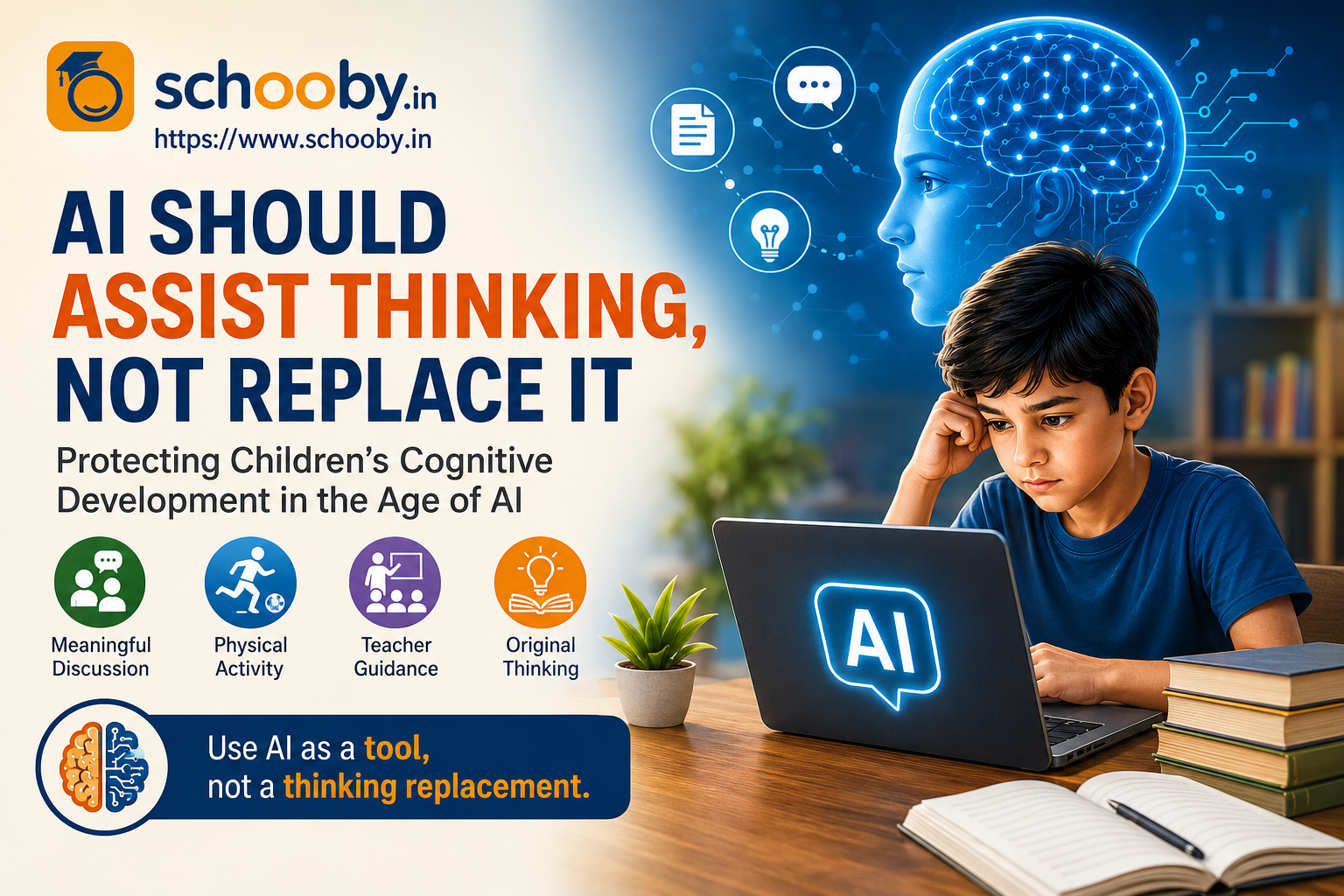
Artificial Intelligence (AI) has become an integral part of our daily lives. From search engines and chatbots to educational apps and personalized learning platforms, AI is transforming how we learn, work, and communicate. While these technologies offer tremendous benefits, recent research raises an important concern: Are children becoming too dependent on AI tools?
A study conducted by researchers at Stanford University, reviewing more than 800 research papers, highlights a growing issue. AI tools can help complete tasks quickly and efficiently, but excessive dependence on them may gradually reduce children’s ability to think independently. Researchers describe this phenomenon as “Cognitive Surrender”—a situation in which people begin to hand over their thinking and decision-making responsibilities to machines.
This finding is particularly important for parents, teachers, and educational institutions because today’s children are growing up in a world where AI is becoming increasingly accessible.
Understanding Cognitive Surrender
Human intelligence develops through observation, questioning, reasoning, problem-solving, and reflection. When children struggle with a mathematical problem, write an essay, or engage in a debate, their brains actively build cognitive connections. These activities strengthen critical thinking, creativity, and decision-making skills.
However, when AI provides immediate answers to every question, children may begin to bypass the thinking process altogether. Instead of analyzing information, comparing alternatives, or forming their own opinions, they may simply accept AI-generated responses as final.
Over time, this habit can weaken essential mental abilities such as:
- Critical thinking
- Problem-solving
- Creativity
- Logical reasoning
- Independent decision-making
- Curiosity and inquiry
The concern is not that AI is harmful by itself. Rather, the danger arises when AI becomes a substitute for thinking instead of a tool that supports learning.
Why Children Are More Vulnerable
Adults often possess established knowledge, experience, and judgment that help them evaluate AI-generated information. Children, however, are still developing these skills.
Young learners naturally seek quick answers. If every question can be solved instantly by an AI chatbot, they may lose opportunities to explore, experiment, make mistakes, and learn through discovery.
For example, a student asked to write an essay may simply generate one using AI instead of researching, organizing ideas, and expressing personal viewpoints. While the assignment may be completed quickly, the learning process is largely skipped.
Similarly, students solving mathematics problems may rely on AI-generated solutions without understanding the underlying concepts. In the short term, they finish homework faster. In the long term, they may struggle when faced with unfamiliar situations that require independent reasoning.
The Benefits of AI When Used Correctly
Despite these concerns, AI should not be viewed as an enemy of education. In fact, it offers remarkable opportunities when used responsibly.
AI can:
- Explain difficult concepts in simple language.
- Provide personalized learning experiences.
- Offer instant feedback.
- Help students practice skills.
- Assist teachers in lesson planning.
- Make education more accessible.
The key is to use AI as a learning assistant rather than a thinking replacement.
For instance, instead of asking AI to complete an entire assignment, students can use it to understand concepts, generate ideas, or check their work. This approach encourages learning while still benefiting from technological support.
The Importance of Meaningful Discussion
One of the most effective ways to preserve children’s thinking abilities is through meaningful conversations.
When children discuss ideas with parents, teachers, and peers, they learn to:
- Express opinions
- Defend arguments
- Listen to different perspectives
- Evaluate evidence
- Develop communication skills
Discussion encourages active thinking in ways that AI cannot fully replicate.
Schools should create more opportunities for classroom debates, group discussions, collaborative projects, and problem-solving activities. Families can also support this by engaging children in conversations about current events, ethical issues, and everyday decisions.
Physical Activity Supports Cognitive Growth
The Stanford research also emphasizes the importance of physical activity.
Exercise is not only beneficial for physical health; it also improves brain function. Studies consistently show that regular physical activity enhances:
- Memory
- Concentration
- Creativity
- Emotional well-being
- Learning capacity
When children spend excessive time interacting with screens and AI-powered devices, they often miss opportunities for movement, outdoor exploration, and social interaction.
Sports, games, yoga, walking, cycling, and outdoor play all contribute to healthier cognitive development. A balanced lifestyle helps children maintain both mental and physical fitness.
The Continuing Role of Teachers
Technology can never replace the human connection that teachers provide.
Teachers do much more than deliver information. They inspire curiosity, encourage questions, identify misconceptions, provide emotional support, and guide students through complex learning journeys.
An AI system may answer a question, but a teacher can understand why a student is confused and adapt instruction accordingly.
Educators should help students learn how to use AI responsibly by teaching:
- Digital literacy
- Information evaluation
- Fact-checking
- Ethical AI usage
- Independent research skills
The goal is not to prevent students from using AI but to help them become thoughtful and responsible users.
Encouraging Original Thinking
Original thinking is one of the most valuable skills for the future.
As AI becomes capable of generating text, images, code, and solutions, human creativity will become even more important. The ability to imagine new possibilities, ask meaningful questions, and develop innovative ideas cannot be outsourced entirely to machines.
Parents and educators can nurture originality by encouraging children to:
- Ask questions
- Solve open-ended problems
- Create projects
- Write stories
- Design experiments
- Explore hobbies
- Think beyond standard answers
These experiences help build confidence and intellectual independence.
Finding the Right Balance
Technology has always influenced education, from calculators and computers to smartphones and AI assistants. The challenge is not whether to use technology but how to use it wisely.
AI should function like a bicycle for the mind—it should help people travel further and faster, not eliminate the need to think and move altogether.
Children should be encouraged to:
- Think first and use AI later.
- Verify AI-generated information.
- Discuss ideas with others.
- Spend time in physical activities.
- Learn under the guidance of teachers and mentors.
- Develop their own opinions and solutions.
Conclusion
Artificial Intelligence is one of the most powerful educational tools ever created. However, its greatest value lies in enhancing human intelligence, not replacing it.
The Stanford research serves as an important reminder that while AI can save time and increase efficiency, children must continue to develop the essential human skills of reasoning, creativity, curiosity, and independent thinking.
By balancing AI usage with meaningful discussion, physical activity, teacher guidance, and opportunities for original thought, we can ensure that technology strengthens rather than weakens the next generation’s cognitive abilities.
The future belongs not to those who simply use AI, but to those who know how to think alongside it.