
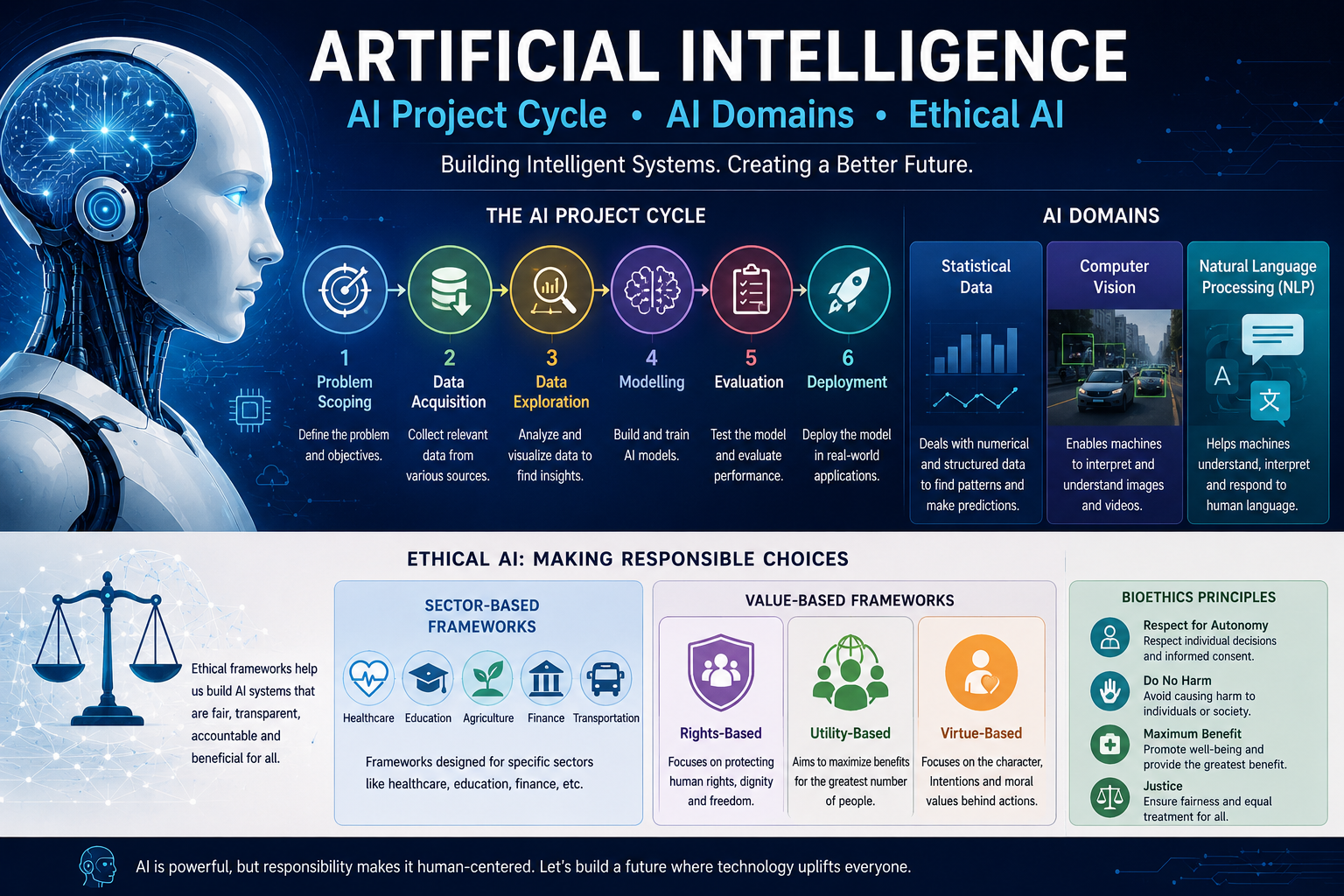
Artificial Intelligence (AI) is transforming the way we live, learn, and work. From voice assistants and recommendation systems to self-driving cars and medical diagnosis tools, AI is becoming an essential part of our daily lives. However, building intelligent systems requires a structured approach and responsible decision-making. This is where the AI Project Cycle, AI Domains, and Ethical Frameworks come into play.
In this article, we will explore the fundamentals of AI development and understand why ethics is just as important as technology.
What is the AI Project Cycle?
Just like any successful project, an AI solution follows a systematic process called the AI Project Cycle. It provides a roadmap for developing AI applications effectively and efficiently.
1. Problem Scoping
The first step is identifying and defining the problem that needs to be solved. A clear understanding of the objective helps in designing a meaningful AI solution.
Example: Predicting traffic congestion in a city.
2. Data Acquisition
AI systems learn from data. In this stage, relevant data is collected from reliable sources such as surveys, databases, sensors, websites, or historical records.
3. Data Exploration
Collected data is analyzed to identify patterns, trends, and relationships. Visualization tools like graphs and charts help in understanding the data better.
4. Modelling
The AI model is created and trained using the collected data. The model learns patterns and attempts to make predictions or decisions.
5. Evaluation
The model is tested to check its accuracy and performance. Any errors or limitations are identified and improvements are made.
6. Deployment
Once the model performs satisfactorily, it is deployed in real-world applications where users can interact with it.
The AI Project Cycle is iterative, meaning developers can revisit earlier stages to improve results and enhance performance.
Understanding AI Domains
Artificial Intelligence can be broadly classified into three major domains based on the type of data it processes.
1. Statistical Data
This domain focuses on collecting, managing, and analyzing large amounts of numerical or structured data.
Examples:
- Price comparison websites
- Sales forecasting systems
- Business analytics dashboards
- Financial prediction tools
Statistical Data helps organizations make informed decisions based on patterns and insights extracted from data.
2. Computer Vision
Computer Vision enables machines to understand and interpret visual information such as images and videos.
Applications:
- Face recognition systems
- Agricultural crop monitoring
- Medical image analysis
- Security and surveillance systems
Computer Vision teaches machines to “see” and make decisions based on visual inputs.
3. Natural Language Processing (NLP)
Natural Language Processing focuses on enabling computers to understand, interpret, and respond to human language.
Applications:
- Chatbots and virtual assistants
- Language translation systems
- Email spam filters
- Voice assistants like Siri and Alexa
NLP bridges the communication gap between humans and machines by making interactions more natural and intuitive.
Why Ethics Matters in Artificial Intelligence
AI systems influence decisions that can impact people’s lives. If these systems are biased or unfair, they can cause significant harm. Ethical frameworks help developers ensure that AI solutions are fair, transparent, and beneficial to society.
What are Ethical Frameworks?
Ethical Frameworks are structured approaches that guide decision-making by considering moral values and societal impact.
They help answer important questions such as:
- Is this decision fair?
- Could this harm someone?
- Are all individuals being treated equally?
- Does the solution respect human rights?
Types of Ethical Frameworks
1. Sector-Based Frameworks
These frameworks are designed for specific industries or sectors.
Examples include:
- Healthcare
- Education
- Finance
- Agriculture
- Transportation
One of the most widely used sector-based frameworks is Bioethics, which focuses on healthcare-related ethical concerns.
2. Value-Based Frameworks
These frameworks are based on fundamental moral principles and values.
Rights-Based Framework
Focuses on protecting human rights, dignity, and freedom.
Key Question: Does this decision respect individual rights?
Utility-Based Framework
Aims to maximize benefits for the greatest number of people while minimizing harm.
Key Question: Does this decision create the greatest overall good?
Virtue-Based Framework
Focuses on the character and intentions behind decisions.
Key Question: Is this action honest, fair, and compassionate?
Bioethics: Ethics in Healthcare AI
Bioethics is an ethical framework used in healthcare and life sciences to ensure responsible decision-making.
It is built on four key principles:
Respect for Autonomy
Individuals should have the right to make informed decisions about matters affecting them.
Do No Harm (Non-Maleficence)
AI systems should avoid causing harm to people or society.
Maximum Benefit (Beneficence)
AI should actively contribute to improving lives and generating positive outcomes.
Justice
Benefits and risks should be distributed fairly among all individuals regardless of background.
The Challenge of AI Bias
One of the biggest concerns in AI development is bias. If training data contains inaccuracies or reflects societal inequalities, AI systems may unintentionally make unfair decisions.
For example, a healthcare AI model trained on biased data may provide less accurate recommendations for certain groups of people. This highlights the importance of using diverse, accurate, and unbiased datasets.
Developers must continuously evaluate AI systems to ensure fairness, transparency, and accountability.
Building Responsible AI for the Future
Artificial Intelligence has enormous potential to solve complex problems and improve lives. However, technological advancement must go hand in hand with ethical responsibility.
By following the AI Project Cycle, understanding different AI domains, and applying ethical frameworks, we can create AI systems that are not only intelligent but also fair, trustworthy, and beneficial for society.
The future of AI depends not just on how smart our machines become, but on how wisely we choose to build and use them.
Final Thought
“Artificial Intelligence is not just about creating intelligent machines—it is about creating technology that serves humanity responsibly.”