
CBSE Computational Thinking & AI for Classes 3 to 9
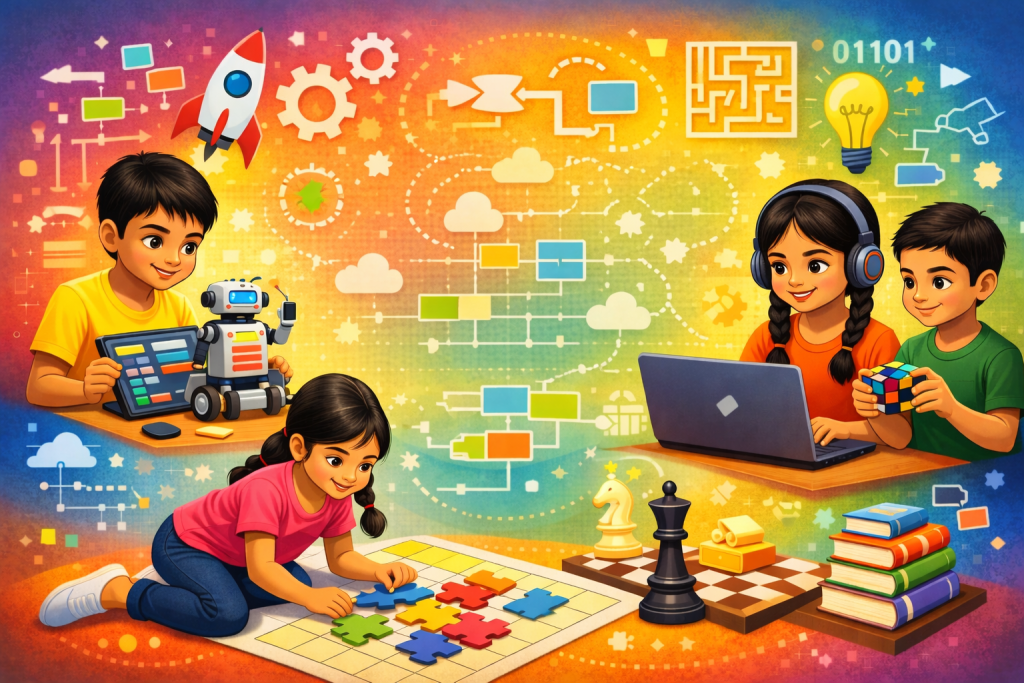
The Indian education system is evolving rapidly, and one of the most significant changes is the introduction of Computational Thinking (CT) and Artificial Intelligence (AI) in school education.
The Central Board of Secondary Education (CBSE) has taken a progressive step by integrating these future-ready skills into the curriculum starting from Classes 3 to 8, with further expansion in Class 9 and beyond.
This move marks a shift from traditional rote learning to skill-based, application-oriented education.
🚀 Why Has CBSE Introduced Computational Thinking and AI?
The introduction of CT and AI aligns with the vision of the National Education Policy (NEP) 2020, which focuses on:
- Critical thinking
- Problem-solving skills
- Creativity and innovation
- Real-world application of knowledge
The goal is to prepare students for a future where technology, data, and intelligent systems play a major role.
🧩 What is Computational Thinking?
Computational Thinking is not just about coding. It is a problem-solving approach that helps students think logically and systematically.
It includes:
- Decomposition: Breaking problems into smaller parts
- Pattern Recognition: Identifying similarities and trends
- Abstraction: Focusing on important information
- Algorithmic Thinking: Creating step-by-step solutions
These skills are essential not only in technology but also in everyday decision-making.
🤖 What Do Students Learn in Artificial Intelligence?
Artificial Intelligence introduces students to the basics of how machines work with data and make decisions.
Key learning areas include:
- Understanding data and patterns
- Basics of machine learning concepts
- Real-life applications of AI (healthcare, transport, education)
- Ethical use of technology and data
The aim is to build awareness and understanding, not just technical skills.
📚 CBSE Curriculum Structure for CT & AI
🟨 Classes 3–5: Foundation Stage
At this stage, learning is:
- Activity-based and interactive
- Focused on puzzles, games, and patterns
- Integrated with subjects like Mathematics
Students develop logical thinking and curiosity without heavy reliance on technology.
🟩 Classes 6–8: Exploration Stage
Students begin to explore:
- Data handling and interpretation
- Logical reasoning and decision-making
- Introduction to AI concepts
- Real-life problem-solving
The focus remains on understanding concepts through activities rather than memorization.
🟦 Class 9 and Beyond
From Class 9 onwards:
- Students can opt for structured AI-related subjects
- Learning becomes more application-based
- Exposure to data science, coding, and AI increases
Board examinations are also gradually shifting toward competency-based assessment.
🎯 Key Features of the New CBSE CT & AI Curriculum
- Introduced from Class 3 onwards
- Focus on skills over rote learning
- Encourages interdisciplinary learning
- Promotes ethical use of technology
- Emphasizes activity-based learning
- Develops real-world problem-solving abilities
⚠️ Does This Mean More Screen Time for Students?
A common concern among parents is whether this new curriculum will increase screen time.
The answer is: Not necessarily.
In fact:
- Early stages focus on unplugged activities
- Learning is often paper-based and hands-on
- Emphasis is on thinking skills rather than devices
This ensures a balanced approach where students learn concepts without becoming overly dependent on screens.
👨👩👧 What This Means for Parents
With the introduction of Computational Thinking and AI, the expectations from students are changing.
Parents should now focus on helping children:
- Develop strong thinking habits
- Improve problem-solving abilities
- Build curiosity and creativity
- Apply learning in real-life situations
Academic success is no longer just about marks — it is about skills and understanding.
🌟 Why These Skills Are Important for the Future
The future job market will require:
- Analytical thinking
- Decision-making ability
- Creativity and innovation
- Understanding of technology
By introducing CT and AI early, students are better prepared to adapt to these demands.
🎓 Final Thoughts
The introduction of Computational Thinking and Artificial Intelligence in CBSE schools is a significant step toward modern education.
It reflects a clear shift:
From memorizing information → To understanding and applying knowledge
For students, this means better preparation for future careers.
For parents, it means supporting children in developing thinking skills beyond textbooks.
📢 Conclusion
As education evolves, one thing is clear:
Students who can think, analyze, and solve problems will have a strong advantage.
The CBSE’s initiative to introduce CT and AI is not just a curriculum change — it is a transformation in how children learn and grow.